Whole-House Design Case Study | A Tranquil Tea-Contemplation Realm: A Healing Aesthetic Uniquely Eastern
Living Knowledge · 2025.03.06

Whole-House Design Case Study | A Tranquil Tea-Contemplation Realm: A Healing Aesthetic Uniquely Eastern

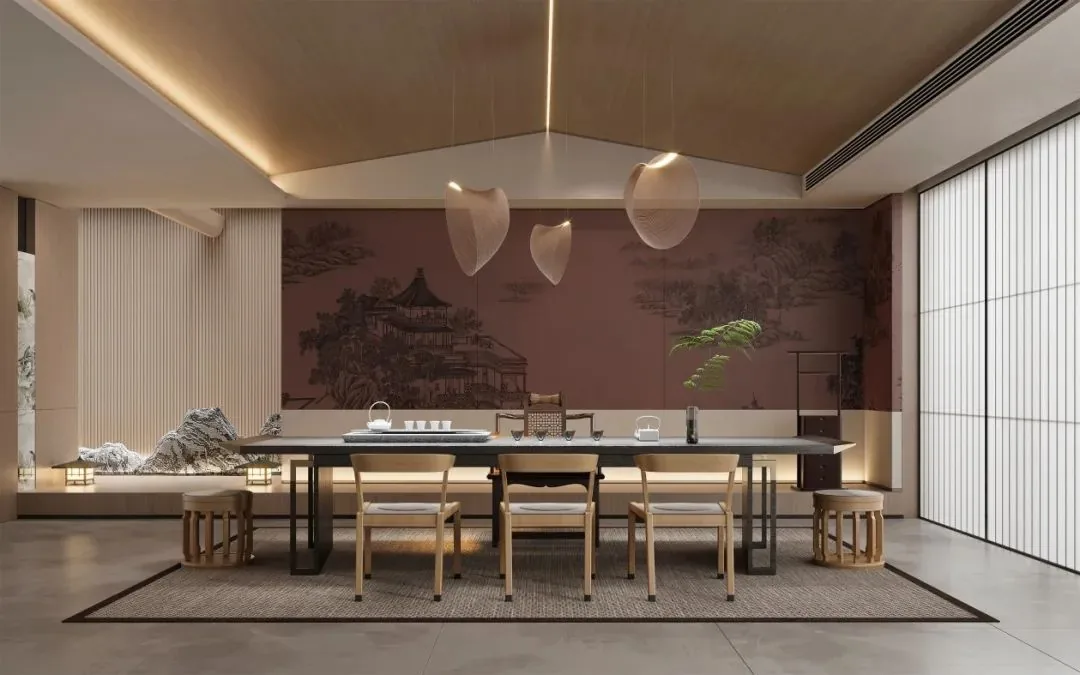
‘On short paper, slanting script flows idly; at a sunlit window, fine tea foam is playfully divided.’ Brew a cup of clear tea, recite an ancient poem. Time flows gently; tea fragrance lingers softly—amid the haze, one seems to resonate with sages of old, sharing their refined elegance. A poetic tea lifestyle returns us to stillness, nourishes body and mind, harmonizes with inner calm, merges with art, and integrates seamlessly with space. Tea · Realm: A New Chinese-Style Tea Space. Its design employs symmetrical layouts to convey order and grace, incorporates classical motifs to express scholarly elegance, and cultivates a serene, understated ambiance—creating a sanctuary for its inhabitants, embodying their aesthetic sensibilities and personal aspirations. ‘Tea should be enjoyed beneath a tiled roof and behind paper windows…’

With paper low and brush slanting, I idly write cursive script; beneath a sunlit window, I savor fine tea with delicate froth.

Brew a cup of clear tea and recite an ancient poem.

Time flows gently; tea fragrance lingers softly—within this hazy stillness, we seem to resonate in harmony with the ancients, jointly appreciating the elegance of refined aesthetics.

A poetic tea lifestyle: returning to tranquility, nurturing body and mind, aligning with inner serenity, integrating with art, and harmonizing with space.

Tea · Realm

A new Chinese-style tea space—designed with symmetrical layouts to convey order and grace, enriched with classical motifs that embody scholarly elegance. Serene and understated, it creates a sanctuary for its inhabitants—a pure haven reflecting their aesthetic sensibility and personal aspirations.

‘Tea should be enjoyed beneath a tiled roof and paper windows, with spring water and green tea, served in simple, elegant ceramic ware alongside two or three companions—half a day’s leisure can rival ten years’ worldly dreams.’ So wrote the writer Zhou Zuoren.

From ancient times to today, tea has never been merely a beverage—it is also heartfelt solace.

Tea · Rhythm

An antique-inspired tea room, grounded in natural wood tones and accented by a vibrant, welcoming pine tree—its refreshing, organic essence blending seamlessly with the subtle resonance of tea. Even amid life’s clamor and bustle, one may still inhale a gentle, soothing aroma of tea.

‘Witty words bring delight; fine tea clears the mind.’

Tea smoke drifts softly; leaves unfurl gracefully; seated quietly by the window, one savors each sip with mindful presence.

Tea releases a delicate fragrance, easing inner stress and calming restless thoughts—allowing heartfelt words to emerge naturally and making conversation more effortless and life more buoyant.

Tea & Zen

Beauty lies in the harmonious proportion of all parts, enhanced by a pleasing color." Inspired by Zen philosophy, the New Chinese-style tea room employs thoughtful color contrasts and subtle Chinese motifs to create a soothing, rhythmic ambiance—one that resonates with the occupant’s mindset and nurtures a warm, restorative space.

Entering Zen through tea; attaining insight through Zen.

Tasting tea is tasting life; tasting tea is tasting existence.

Tea offers both sweetness and bitterness—much like life itself. Only by savoring it mindfully can we perceive life’s myriad nuances and grasp the profound truth of serene clarity and far-reaching vision.

Exploring the philosophy of living aesthetics and shaping spatial form and scale, BOSNIE Private Residence Customization draws on 24 years of industry expertise—designing from the client’s lifestyle needs, integrating aesthetic sensibility with natural harmony to craft dream-worthy private residences.
More Articles

More Posts
How should the internal structure of a custom wardrobe be designed to maximize usability? The zoning logic determines storage efficiency.
Living Knowledge · 2026.10.29

How should the internal structure of a custom wardrobe be designed to maximize usability? The zoning logic determines storage efficiency.

How should you design the internal structure of a custom wardrobe to make it truly functional? The zoning logic determines storage efficiency. The effectiveness of a custom wardrobe depends on whether its internal layout aligns with your household’s actual clothing inventory and your habits for putting things in and taking them out. The correct design sequence is: first, take stock of your clothes; second, determine the zones; and only then consider the overall style. This article provides a set of zoning principles and dimension guidelines that you can apply directly. 1. Inventory First, Design Later: A wardrobe is a reflection of your clothing collection...

How to coordinate color schemes for whole-house customization? The 60-30-10 rule and four space-specific strategies.
Living Knowledge · 2026.10.29

How to coordinate color schemes for whole-house customization? The 60-30-10 rule and four space-specific strategies.

How do you coordinate colors for whole‑house customization? The 60–30–10 rule and four space‑specific strategies. The most common reason why color schemes in whole‑house customization fall flat isn’t that the colors themselves are unattractive, but rather that there are too many colors, the proportions are out of balance, or the materials and colors aren’t well integrated. Master one fundamental principle—the 60–30–10 ratio—and then choose a strategy based on the specific spatial conditions, and you’ll be able to make color choices you won’t regret. I. The 60–30–10 Rule: Let each color...

A Guide to Avoiding Pitfalls in Whole-House Customization: 6 Things You Must Confirm Before Signing the Contract
Living Knowledge · 2026.10.29

A Guide to Avoiding Pitfalls in Whole-House Customization: 6 Things You Must Confirm Before Signing the Contract

1. Board Material Environmental Safety: Rely on Test Reports, Not Verbal Promises It’s common for sellers to tout “environmentally friendly boards” without providing any official test reports. The formaldehyde emission limit for E1‑grade boards is ≤0.124 mg/m³; some retailers use this as a claim of eco‑friendliness, but it falls short for households with elderly residents or young children. A more reliable choice would be ENF‑grade (≤0.025 mg/m³) or E0‑grade (≤0.05 mg/m³), ...

BOOK A CONSULTATION

Want to Apply These Ideas to Your Own Home?

It can explain the apartment area, decoration stage and preferred style. The BOSNIE team will combine the home encyclopedia, real cases and product systems to provide one-to-one custom suggestions for the entire home.